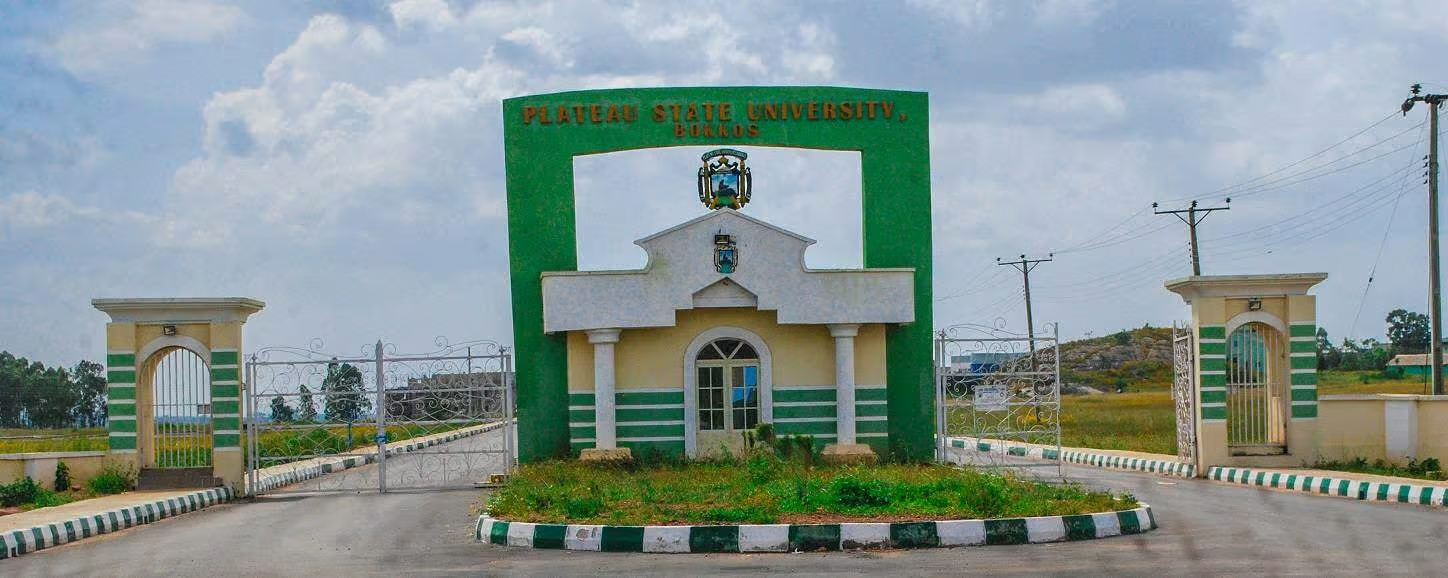
PLASU
PLASU Important Notice on Tuition Fee Increasement 2025/2026

The management of Plateau State University (PLASU), Bokkos, has clarified that there has been no increase in tuition fees for the 2025/2026 academic session. This statement comes in response to recent social media posts suggesting a fee hike.

According to an internal memorandum signed by the Registrar, Yakubu F. Ayuba, and sent to all students, the university confirmed that tuition fees for both new and returning students have stayed the same since 2022. Despite rising costs and inflation, PLASU has maintained its fee structure to ease the financial pressure on students.


The memo further explained that the confusion may have been caused by the introduction of a new ₦5,000 ICT charge, which is entirely separate from tuition fees. This charge was approved by the University’s Governing Council to support ICT services and provide free internet access across campus.

It also restated that the ₦10,000 Bench Fee, introduced in 2021 to replace irregular departmental levies, remains unchanged. Initially meant for final-year students, the fee now applies to students in 22 departments whose programmes involve outdoor learning activities such as fieldwork, excursions, and productions.

The university encouraged students to make use of the Nigerian Education Loan Fund (NELFUND) made available by the Federal Government. This initiative aims to reduce financial challenges connected with tuition and related payments.

PLASU
See PLASU Academic Calendar for 2025/2026 Session

Plateau State University has released the academic calendar for the 2025–2026 session. It contains dates for registration, lectures, exams, and staff breaks. All students are encouraged to check the schedule and keep to the timeline.

The Plateau State University (PLASU) has announced its academic calendar for the 2025–2026 school year. With a long list of dates already set, both students and staff now have a map of what to expect. From freshers’ orientation to semester exams, the timetable lays it all bare.

First Semester Activities

The first semester begins in late September and runs into February. Things are expected to move quickly, with only short pauses in between.

  • Monday, 29th September, 2025: Registration starts for fresh students.
  • Monday, 6th October, 2025: Returning students begin registration.
  • Monday, 13th October, 2025: Normal registration ends, lectures also commence.
  • Monday, 3rd November, 2025: Admission closes.
  • Tuesday, 4th – Thursday, 6th November, 2025: Orientation for new students.
  • Friday, 7th November, 2025: Matriculation ceremony.
  • Monday, 22nd December, 2025 – Friday, 2nd January, 2026: Christmas break.
  • Monday, 5th January, 2026: School reopens.
  • Friday, 9th January, 2026: Lectures for the semester end.
  • Monday, 12th – Friday, 16th January, 2026: Revision week, C.A scores due.
  • Monday, 19th January, 2026: Examinations begin.
  • Wednesday, 4th February, 2026: Exams end.
  • Tuesday, 17th – Friday, 20th February, 2026: Boards meet to review results.
  • Monday, 23rd February – Friday, 27th March, 2026: Scrutiny of results continues.
  • Thursday, 5th March, 2026: Senate meets for approval.

The semester is packed, with about fifteen weeks of lectures, two weeks for exams, and nearly a month for marking and approvals.

Second Semester Activities

The second semester flows right after, kicking off in March and running till July. It comes with its own rhythm, slightly shorter but just as busy.

  • Monday, 2nd March, 2026: Lectures start.
  • Friday, 15th May, 2026: Lectures end.
  • Monday, 18th – Friday, 22nd May, 2026: Revision week, continuous assessment scores ready.
  • Monday, 25th May, 2026: Examinations begin.
  • Wednesday, 10th June, 2026: Exams wrap up.
  • Monday, 15th June, 2026: Industrial Attachment commences.
  • Tuesday, 23rd – Friday, 26th June, 2026: Boards meet to consider sessional results.
  • Monday, 29th June – Friday, 3rd July, 2026: Results scrutiny.
  • Monday, 13th July, 2026: Senate sits for approval.
  • Wednesday, 15th July – Wednesday, 26th August, 2026: Academic staff take annual leave.
  • Friday, 4th September, 2026: Industrial Attachment ends.

In total, the second semester has twelve weeks of lectures, two weeks of exams, and close to a month for marking and result approval.

Plateau College of Health Technology, Zawan CHT-ZAWAN
See PLASU Departmental Admission Cut-Off Marks for 2025/2026

Plateau State University has released its 2025/2026 departmental cut-off marks. This guide lists the required scores for each course and helps you figure out where you stand. Read through if PLASU is on your list.

So you’ve done the hard part — wrote the UTME, probably refreshed the JAMB portal more times than you’d admit, and now, you’re wondering if your score will get you into Plateau State University (PLASU). The school has finally released its departmental cut-off marks for the 2025/2026 academic session. No long story. Just raw numbers and what they mean for you.

If you’re eyeing Nursing or Mass Comm, brace yourself. If it’s Crop Production or Theatre Arts, you might breathe easier. Or maybe not. Let’s break it all down.

First, What Are Cut-Off Marks?

For those hearing about them for the first time, cut-off marks are like the score you need to meet — or beat — if you want to be considered for a course. Each department has its own, based on how many people apply and how competitive the course is.

Now, let’s look at the list.

College of Health Sciences

You probably guessed right — this faculty is tight.

  • Medical Laboratory Science – 230
  • Nursing Science – 230
  • Public Health – 210

College of Medicine

One course here, and it’s as high as you’d expect.

  • Medicine and Surgery – 230

College of Pharmaceutical Sciences

Also one course, also high.

  • Pharmacy – 230

Faculty of Agricultural Sciences

Good news if you’re into farming or agribusiness. The bar’s more friendly here.

  • Crop Production – 160
  • Animal Production – 160
  • Agricultural Economics and Extension – 160

Faculty of Arts

  • English Language – 160
  • History and International Studies – 160
  • Religious and Cultural Studies – 160
  • Theatre Arts – 180

So if you’re that dramatic soul who wants to act or direct, Theatre Arts might still give you a run.

Faculty of Environmental Sciences

  • Architecture – 160
  • Building – 160
  • Geography – 160

Faculty of Education

Whether it’s Maths, Biology or CRS, the cut-off is the same.

  • Biology Education – 160
  • Mathematics Education – 160
  • Chemistry Education – 160
  • Physics Education – 160
  • English Education – 160
  • Christian Religious Studies Education – 160

Faculty of Law

Not for the faint-hearted.

  • Law – 220

So if you’re planning to wear the wig and gown, better come prepared.

Faculty of Management Sciences

  • Accounting – 180
  • Management Studies – 160
  • Entrepreneurial Science – 170

Faculty of Natural and Applied Sciences

This one’s long, so take it slow.

  • Biochemistry – 180
  • Chemistry – 160
  • Computer Science – 170
  • Mathematics – 160
  • Microbiology – 170
  • Physics – 160
  • Plant Science and Biotechnology – 160
  • Zoology – 160
  • Statistics – 160
  • Information Technology – 160

If you’re into tech or science, there’s range here. Not every course hits 180.

Faculty of Social Sciences

This part is packed and fairly balanced.

  • Political Science – 160
  • Mass Communication – 180
  • Sociology – 180
  • Psychology – 170
  • Economics – 180
  • Library and Information Science – 160

So, What Next?

If your score matches or beats your chosen course’s cut-off, congrats, you’re on the safe side. But if you fall short, you might want to consider a change of course, or try again next year. Life no dey finish.

At the end of the day, cut-off marks don’t define you, but they do set the rules for the game. So play smart.

And if you’re still unsure or trying to choose between two departments, print this out, grab a biro, and start crossing out your options. It might help more than staring at the screen all day.